The Straight Six Brewery

Mk1 Big Healey-the life, times and adventures
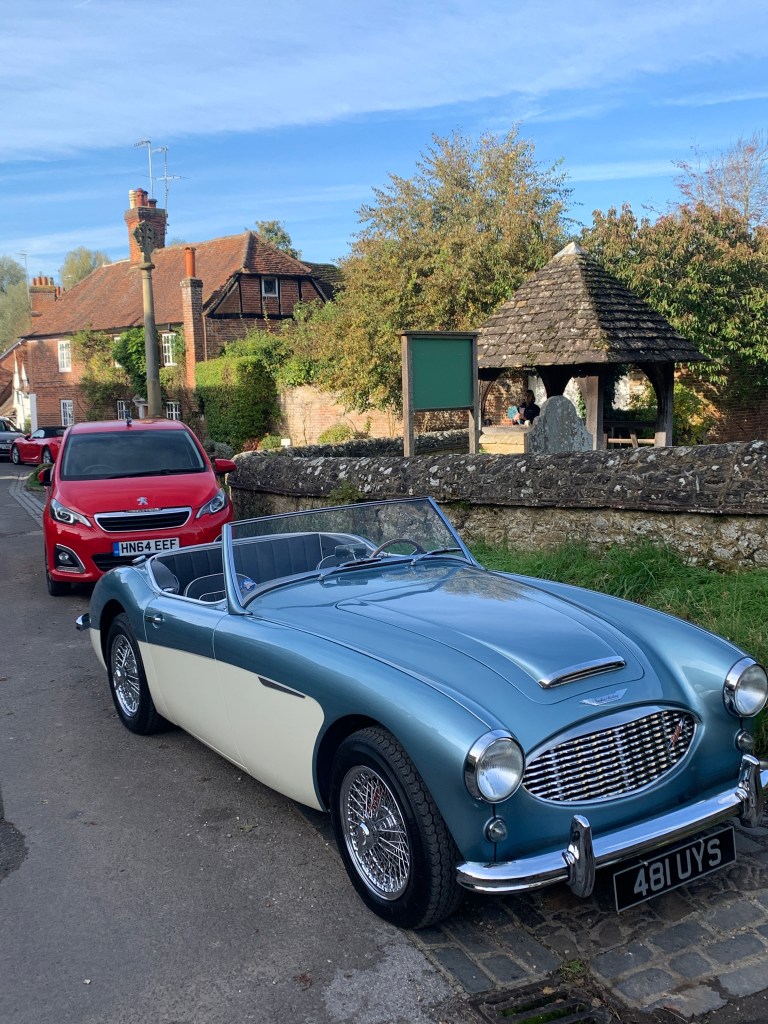
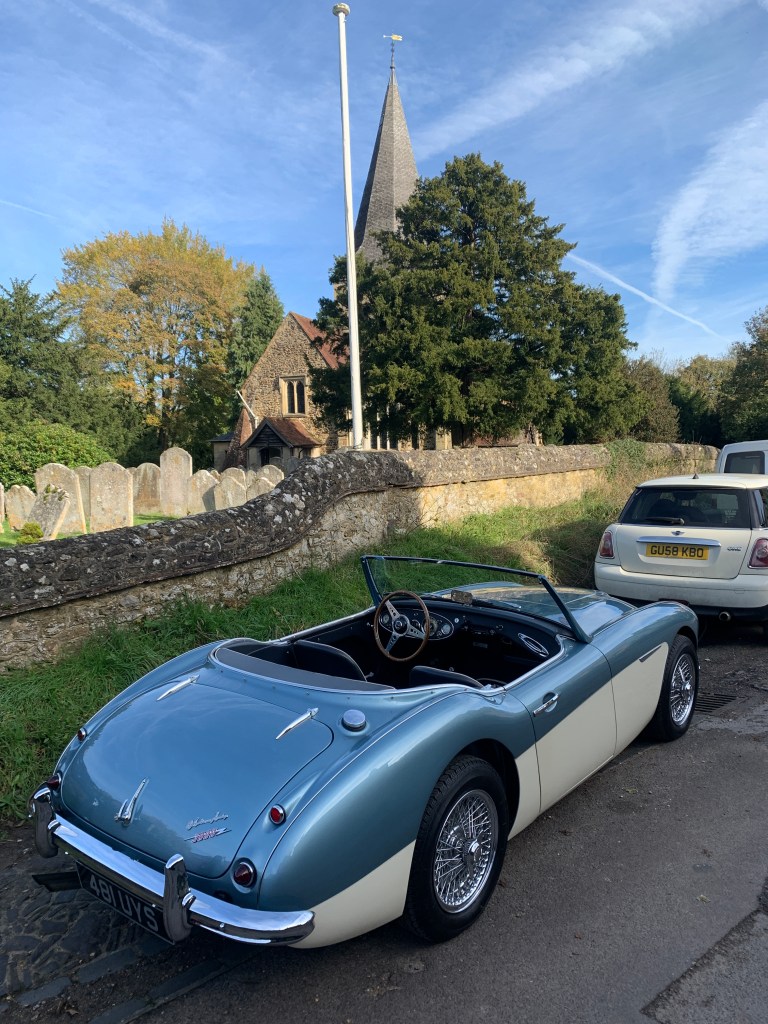
Shere is a beautiful village in the Surrey Hills. Famous for being the setting for filming The Holiday.
Great pubs , cafe and walks . Check out http://www.thedabblingduck.com and http://www.thebray.net
Sorry I missed Goodwood this year but I thought I would share some classic car overtaking moves. (courtesy GRRC)
Donald Healey had thought of building a special streamlined record car, but time was against him to start from scratch. So a decision was taken to use a production car as the basis for the new car. It would be necessary to improve the shape of the body to improve its aerodynamic properties. So a scale model was made of the proposed streamline shape, and as a result of tests carried out by the Armstrong Whitworth Aircraft Ltd. in their wind-tunnel. It was from these results carried out that Healey would need a new front and rear end, with bubble-type Perspex cover for the driver. Austin’s experimental sheet metal department made a revised body that could be fitted to the standard chassis.

From results taken by the Austin technicians on the Streamliner in the wind tunnel, and then comparing this data with results from other models, they calculated the Streamline potential maximum speed would be 200mph.
Now work started on increasing the output of the 100S competition engine, which in standard tune delivered 130 bhp at 4,700 rpm. This engine already had nitrided crankshaft running in trimetal bearings and special cylinder head with enlarged valves and special porting. To eliminate the possible problems using a head gasket, it was decided to lap-in the head to the block.
Dr. J. H. Weaving, head of BMC. Gas Turbine Research, was responsible for the preparation and tuning of this engine. He decided that the best way to get the power needed, would be to supercharge the engine using a standard Shorrock Type C250B. This was the largest one available, and connected to the front of the crankshaft via a Layrub couplings. The maximum boost available was about 8lbs/sq with this setup the engine was now producing 224 bhp at 4,500 rpm
With the extra power generated it was necessary to increase the capacity of the cooling system. Coventry Radiator and Presswork co., Ltd. produced a special radiator core that was installed in the streamlined nose. Tecalment company were involved in suppling a combined oil cooler and filter for the engine, along with a large diameter tube which fed fresh air into the cockpit.
In 1953 the company wished to gain publicity for the Austin Healey specially in the USA. One of the best ways to get press coverage is to break some speed records, and what better place than the Bonneville salts flats in the state of Utah?
In that year Donald Healey Motor Company had built a special version of the Austin-Healey 100 sports car with the aim of setting both high-speed as well as endurance records. This Endurance car, which looked not too dissimilar to a standard Austin-Healey 100 was driven by Donald Healey himself, George Eyston, Carroll Shelby, Mort Goodall, and Roy Jackson Moore.

Date when launched 1959 discontinued in 1961 Total produced Abingdon 2,825 BN7(2-seaters) 10,825 BT7(2+2 seater) Engine 2,912 cc 124bhp at 4,600 rpm Max torque 162 lbs/ft at 2,400 rpm Length 13ft 1.5ins Width 5ft 0.5ins Height (hood) 4ft 1ins Wheelbase 7ft 8ins Track front 4ft 0.8ins rear 4ft 2ins Price ex Works (Oct 1959) £1,168 (2 seater) £1,175 (2+2 seater)
NANCY WAS A EARLY MK1 3000


Donald Healey built cars at Warwick using one basic chassis design in 1946 Donald Healey showed at the 1952 Earls Court Show a new sports car using Austin A90 Atlantic running gear and called it the Healey 100. So impressed was the BMC’s managing director Leonard Lord that a deal was struck, so next morning the model on the stand had a new badge which announced to the world that this was the new Austin Healey 100.

Healey would design the cars and Longbridge would build and market them under the name of Austin-Healey. The actual body/chassis were made for BMC by Thompson of Wolverhampton.
It would take some time to get the sports car into production, at the earliest by the middle of 1953. As a production line would have to be set up at Jensen Motors of West Bromwich to produce the body, with a line set up at Longbridge for the final assemble.
So a decision was made that Donald Healey Motor Company would produce a small batch by hand that would be used mainly for publicity, such as Motor Shows around Europe and America, and also be loaned out for the press to try and the public to view. I’m sure that some would have been used by the team to test components etc.
Donald Healey built cars at Warwick using one basic chassis design in 1946 Donald Healey showed at the 1952 Earls Court Show a new sports car using Austin A90 Atlantic running gear and called it the Healey 100. So impressed was the BMC’s managing director Leonard Lord that a deal was struck, so next morning the model on the stand had a new badge which announced to the world that this was the new Austin Healey 100.
This is a 1948 Westland Abbott Healey the same model participated in the 1948 Mille Miglia. With their 2.4 litre riley engine, they were the fastest production cars in the world. Healey introduces 3 different models that year, the silverstone, the abbott and the elliott.
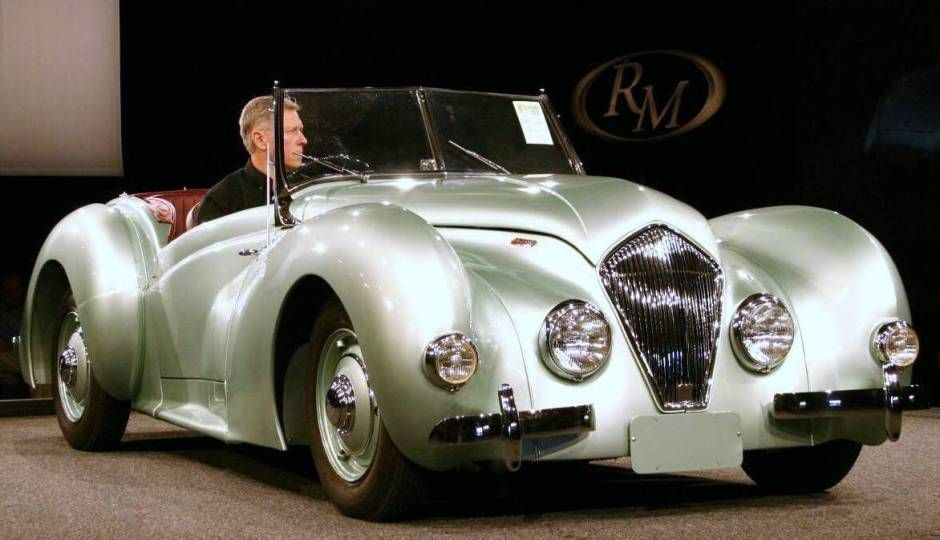
Donald Mitchell Healey (DMH) was born in Perranporth, Cornwall in 3rd July 1898. His parents were John and Emma.
After serving as a pilot in World War I for the RFC (Royal Flying Corps), Donald Healey opens up his first garage in Perranporth. His first car was the Ariel 10 for which he acquired a dealership for Cornwall. With the same car he won the RAC rally.
 Nancy the Austin Healey