In 1953 the company wished to gain publicity for the Austin Healey specially in the USA. One of the best ways to get press coverage is to break some speed records, and what better place than the Bonneville salts flats in the state of Utah?
In that year Donald Healey Motor Company had built a special version of the Austin-Healey 100 sports car with the aim of setting both high-speed as well as endurance records. This Endurance car, which looked not too dissimilar to a standard Austin-Healey 100 was driven by Donald Healey himself, George Eyston, Carroll Shelby, Mort Goodall, and Roy Jackson Moore.
Donald Healey converted 1,159 BN2 versions with a tuned engine. Engine 2660cc comp.ratio 8.1 to 1. 110bhp at 4,500rpm Max torque 143 lbs/ft at 2,600rpm
In 1953 the year that the Austin Healey 100 was announced at the Bonneville Salt Flats, Utah USA, a standard car broke all the American Stock Car Records from 1 to 5,000 km
Model 100 BN1 Date when launched 1953 Discontinued in 1955 Total produced BN1 10,688
Engine 2,660 cc 90bhp at 4,000 rpm Max torque 150 lbs/ft at 2,000 rpm Date when launched 1953 (100 BN1) 1955 (100 BN2)
The first of the line built at Longbridge, with bodies supplied by Jensen was the 2.6 litre Austin-Healey 100 BN1 in 1953. Two years later came the BN2 version. Next on the scene was the BN4 and called the Austin-Healey 100 six which used the “C’ series engine 6 cyl. 2,639 cc. this stayed in production at Longbridge till 1957.
Production was transferred to Abingdon in November 1957, at around the same time the engine was updated by means of a new cylinder head and manifold, this increased power from 102 to 117 bhp.
Later that year (1958) the BN6 arrived using the revised engine, one of the major changes was that the seating reverted back to the original design, making it a two-seater, not 2 + 2 as in the BN4. In 1959 it was change time again with the Austin-Healey 3000 Mk I Engine size went up to 2,912 cc and power output was now 124 bhp at 4,600 rpm with torque at 162 lbs/ft at 2,700 rpm. When the Mk II came out in 1962 it was called a Convertible as it had various changes with a more rounded larger windscreen and windup door windows. The soft top was now a proper foldaway type and seating layout was 2 + 2, although the room in the back was cramped for adults. Power output was again increased and although the overdrive unit was an optional extra, most were fitted with it as standard. It was in 1964 that the Mk III and final version was announced. The model was again given a more powerful engine along with a nice wooden veneer facia. Seating was improved and round the gear change was a central console with a storage box.
Later in 1953 and just after the Mille Miglia the same car was prepared for Le Mans, but when driven back from the scrutineering session by Gordon Wilkins, he was involved in an accident. Because of the major damage, it was necessary to do a total rebuild to get the car ready for the practice session. On event day, bearing the race number 34 it completed 2,153 miles in the 24 hours, finishing in twelve overall and second in class.
This particular car is the only one that to this day is original in all respects.
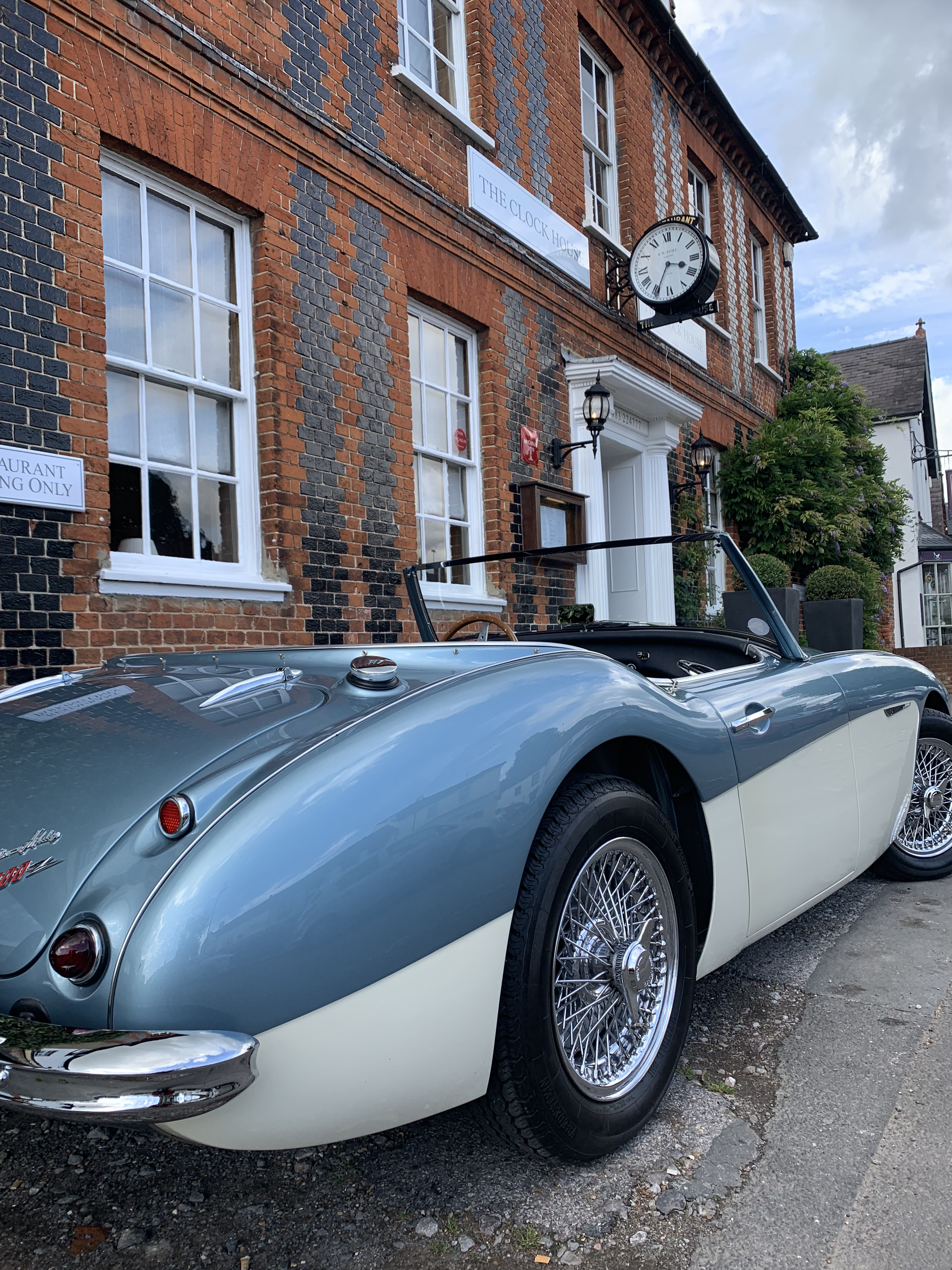
We had a lovely afternoon drive to Ripley in Surrey. The manager @theclockhouseripley #theclockhouseripley kindly let us park in front of the beautiful #michelinstar @michelinstar restaurant . We will be dining here on Sept 21st so will post about the restaurant then. Supposed to be amazing !!
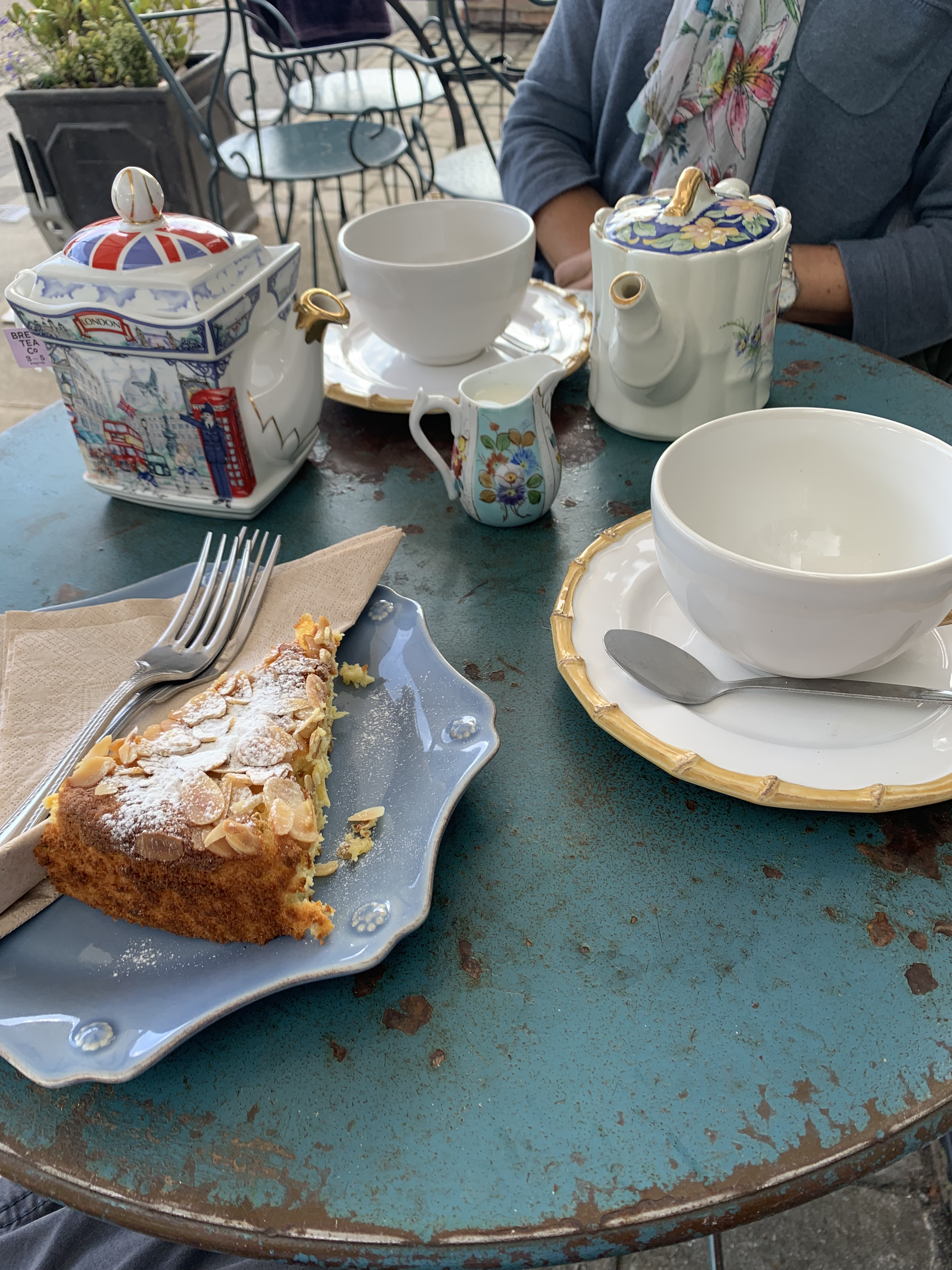
We actually had tea and delicious orange and almond cake #nesthomeandcafe http://www.nest-home.com which is next door the Clock House. Lovely little shop and tea shop, well worth a trip out to visit.
Donald Healeys factory was referred to by the workforce as ‘The Works’ and was actually a former aircraft hangar that was re-erected on three acres of reclaimed land made available by Warwick Council after WWII. Not the ideal place to build a stylish sports car. Offices were added later and also a brick workshop for Roger Menadue to house the experimental department. It was here that the first five cars were assembled. It was planned to produce the next batch of pre-production vehicles in the hanger, a total of fifty, under the watchful eye of Harry Bradish. Actually in the end only nineteen were made at Warwick all been left-hand drive versions.
Donald Healey built cars at Warwick using one basic chassis design in 1946 Donald Healey showed at the 1952 Earls Court Show a new sports car using Austin A90 Atlantic running gear and called it the Healey 100. So impressed was the BMC’s managing director Leonard Lord that a deal was struck, so next morning the model on the stand had a new badge which announced to the world that this was the new Austin Healey 100.
Healey would design the cars and Longbridge would build and market them under the name of Austin-Healey. The actual body/chassis were made for BMC by Thompson of Wolverhampton.
It would take some time to get the sports car into production, at the earliest by the middle of 1953. As a production line would have to be set up at Jensen Motors of West Bromwich to produce the body, with a line set up at Longbridge for the final assemble.
So a decision was made that Donald Healey Motor Company would produce a small batch by hand that would be used mainly for publicity, such as Motor Shows around Europe and America, and also be loaned out for the press to try and the public to view. I’m sure that some would have been used by the team to test components etc. Donald Healey built cars at Warwick using one basic chassis design in 1946 Donald Healey showed at the 1952 Earls Court Show a new sports car using Austin A90 Atlantic running gear and called it the Healey 100. So impressed was the BMC’s managing director Leonard Lord that a deal was struck, so next morning the model on the stand had a new badge which announced to the world that this was the new Austin Healey 100.
Gerry Coker, designer of the Healey 100 working on his drawing board. Gerry was inspired by the appearance of Italian cars. He was responsible for the attractive styling of the Austin Healey’s, a styling that today still fascinate many people.




 Nancy the Austin Healey