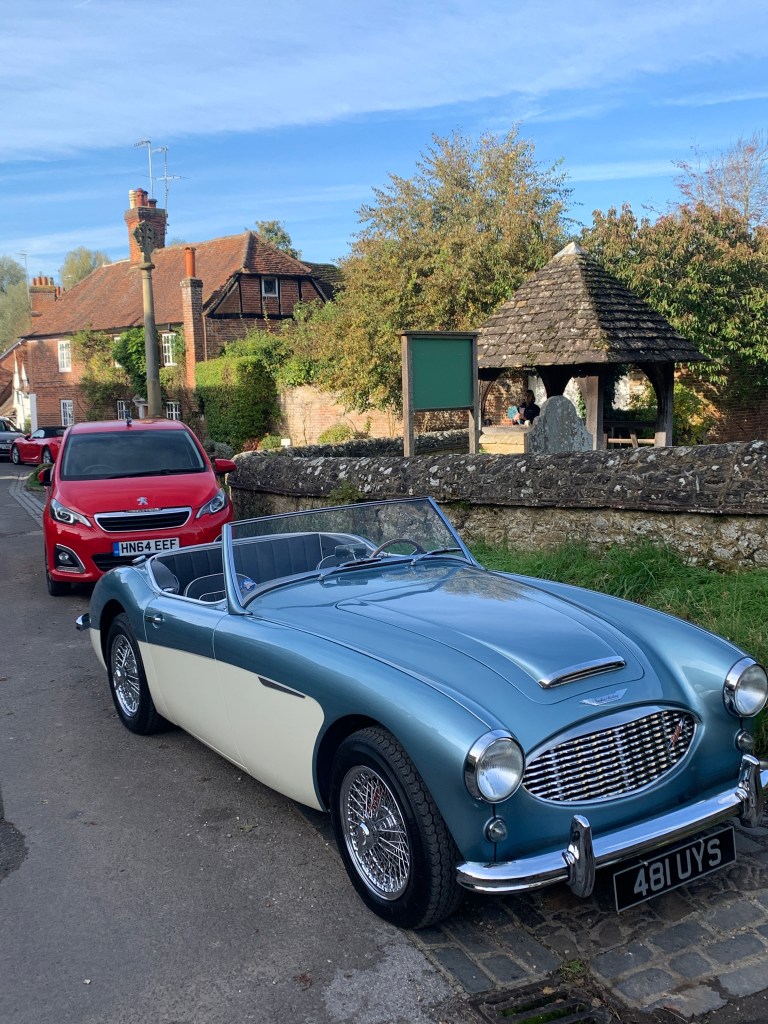
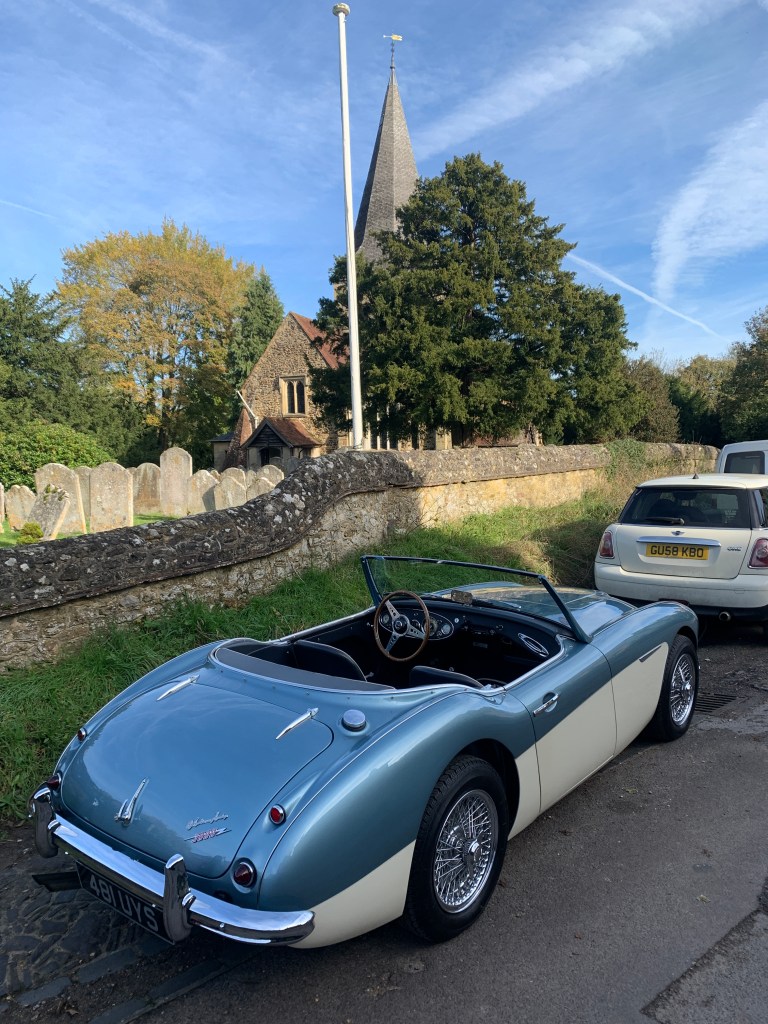
Shere is a beautiful village in the Surrey Hills. Famous for being the setting for filming The Holiday.
Great pubs , cafe and walks . Check out http://www.thedabblingduck.com and http://www.thebray.net

Mk1 Big Healey-the life, times and adventures
Shere is a beautiful village in the Surrey Hills. Famous for being the setting for filming The Holiday.
Great pubs , cafe and walks . Check out http://www.thedabblingduck.com and http://www.thebray.net
Donald Healey had thought of building a special streamlined record car, but time was against him to start from scratch. So a decision was taken to use a production car as the basis for the new car. It would be necessary to improve the shape of the body to improve its aerodynamic properties. So a scale model was made of the proposed streamline shape, and as a result of tests carried out by the Armstrong Whitworth Aircraft Ltd. in their wind-tunnel. It was from these results carried out that Healey would need a new front and rear end, with bubble-type Perspex cover for the driver. Austin’s experimental sheet metal department made a revised body that could be fitted to the standard chassis.

From results taken by the Austin technicians on the Streamliner in the wind tunnel, and then comparing this data with results from other models, they calculated the Streamline potential maximum speed would be 200mph.
Now work started on increasing the output of the 100S competition engine, which in standard tune delivered 130 bhp at 4,700 rpm. This engine already had nitrided crankshaft running in trimetal bearings and special cylinder head with enlarged valves and special porting. To eliminate the possible problems using a head gasket, it was decided to lap-in the head to the block.
Dr. J. H. Weaving, head of BMC. Gas Turbine Research, was responsible for the preparation and tuning of this engine. He decided that the best way to get the power needed, would be to supercharge the engine using a standard Shorrock Type C250B. This was the largest one available, and connected to the front of the crankshaft via a Layrub couplings. The maximum boost available was about 8lbs/sq with this setup the engine was now producing 224 bhp at 4,500 rpm
With the extra power generated it was necessary to increase the capacity of the cooling system. Coventry Radiator and Presswork co., Ltd. produced a special radiator core that was installed in the streamlined nose. Tecalment company were involved in suppling a combined oil cooler and filter for the engine, along with a large diameter tube which fed fresh air into the cockpit.
Date when launched 1955 Discontinued in 1956
Total produced BN2 3,924
Price ex Works BN2 (1956 Jan) £1,126
Engine
2,660 cc 90bhp at 4,000 rpm Max torque 150 lbs/ft at 2,000 rpm
Length 12ft 7ins Width 5ft 0ins Height (hood) 4ft 1ins
Wheelbase 7ft 6ins Track front 4ft 1ins rear 4ft2.8ins

Donald Healey converted 1,159 BN2 versions with a tuned engine.
Engine 2660cc comp.ratio 8.1 to 1. 110bhp at 4,500rpm Max torque 143 lbs/ft at 2,600rpm
1953 after the Mille Miglia
Later in 1953 and just after the Mille Miglia the same car was prepared for Le Mans, but when driven back from the scrutineering session by Gordon Wilkins, he was involved in an accident. Because of the major damage, it was necessary to do a total rebuild to get the car ready for the practice session. On event day, bearing the race number 34 it completed 2,153 miles in the 24 hours, finishing in twelve overall and second in class.
This particular car is the only one that to this day is original in all respects.

The Sixth Austin Healey (build No AHR60) was the second racing car to be built at Warwick. The car had a strengthened but lighter chassis with a special engine No IB 13676 supplied and built by Austin’s Experimental Department Longbridge. With a nitrided crankshaft, special camshaft, racing pistons and lightened flywheel. Various other modifications were carried out and for the Le Mans 24 hour race it was fitted with a cold air box and 1¾ SU carburettors, which helped the engine to produce 103bhp at 4,500rpm. A Borg and Beck competition clutch transmitted the power through to a Austin Taxi gearbox which also had a high ratio overdrive unit, which reduced the engine revs by a third, then finally to a high ratio axle.
It was registered in Birmingham on the 22nd April 1953 and given the number NOJ 392. The chassis number was SPL225B and body No JM 4079-6.
Donald Healey thought that British racing green was unlucky, so it was painted a metallic light green, with dark green leather for the seats. Then entered in the 1953 Mille Miglia with racing number 552, driven by Bert Hadley and Bertie Mercer. Sadly on the stage between Brescia and Ravenna they had to retire with a broken throttle linkage.


Donald Healeys factory was referred to by the workforce as ‘The Works’ and was actually a former aircraft hangar that was re-erected on three acres of reclaimed land made available by Warwick Council after WWII. Not the ideal place to build a stylish sports car. Offices were added later and also a brick workshop for Roger Menadue to house the experimental department. It was here that the first five cars were assembled. It was planned to produce the next batch of pre-production vehicles in the hanger, a total of fifty, under the watchful eye of Harry Bradish. Actually in the end only nineteen were made at Warwick all been left-hand drive versions.
Gerry Coker, designer of the Healey 100 working on his drawing board. Gerry was inspired by the appearance of Italian cars. He was responsible for the attractive styling of the Austin Healey’s, a styling that today still fascinate many people.
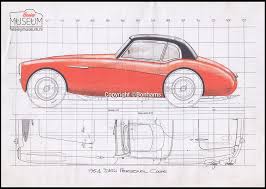
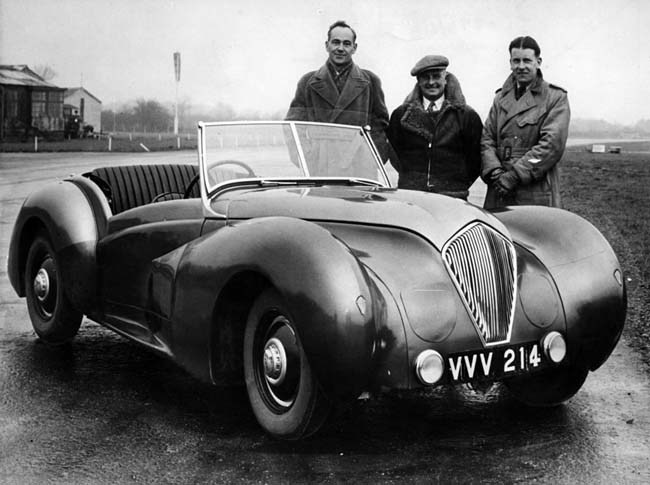
The Healey Westland was designed during the war. Initially Donald wanted to sell his concept to Triumph. That didn’t work out and he took on production himself. The picture was taken at the original factory. Beautiful lines even in the rain !
A good one today will cost $150,000
#classiccar #healeywestland #austinhealeyowners
1898
Donald Mitchell Healey (DMH) was born in Perranporth, Cornwall. This family photo shows Donald Healey with his parents. according to DMH this picture is still the most convincing evidence that he actually possessed hair at some point in his life
 Nancy the Austin Healey