Breaking 200mph

On arriving at the Bonneville Salts Flats they found out that part of the normal track was breaking up. So it was necessary to move the measured mile closer to one end of the timing stretch, thereby reducing the length of the run-in in this direction. Donald Healey drove the car on the straight-away runs and raised the International Class D for 5 kilometres to 182.2 mph and for 10 miles to 181 mph The car was timed over the kilometre at 192.6mph, thereby breaking an American National record. various other runs were completed and one such run broke the magic 200 mph barrier.

Then Carrol Shelby, the Texan driver who competed in many European events during the 1954 season, took over and attacked the International Class D record for the hour, which was duly obtained at a speed of 156.7m.p.h. For this run, a 10-mile circle was used, a course which seemed almost one long straight when seen from behind the wheel of a normal saloon but which seemed more like a rather difficult fast bend from the Streamliner’s cockpit. The car proved very stable, which was indeed fortunate, for conditions were by no means ideal, gusts of up to 30 mph. sweeping across the Salt Flats. Moreover, owing to the complete absence of trees or any other vegetation, the driver received no advance warning of a gust before it struck the car. This is where the tail fin proved to be of real value in such circumstances.

Austin-Healey at speed on the 22 August 1954 on the Bonneville salts USA this modified Austin Healey “100” was timed by the American Automobile association officials over a measured mile at a mean speed of 192.6 MPH. At the same time a number of Class D international records were broken. It is on such occasions that research and development are put to the severest test which motoring have so far devised – record-breaking.

Heading to the Bonneville Salt Flats

Donald Healey had great experience of competition work and was able to recommend various safety precautions. This included a complete Graviner fire extinguisher system, which is mounted for both the engine compartment and the fuel compartment in the tail that holds the 25 gallon tank. The system was fitted with an impact switch which brought it into operation automatically should the car sustain an impact above a set figure. The system could also be operated by the driver, with a red button that replaced the normal horn button in the centre of the steering wheel. Instead of the normal steering wheel the Austin Healey works produced a special rectangular shape for Donald Healey as a normal wheel interfered considerably with his vision from the cockpit. 

Other safety devices included a crash arch behind the driver, two levers, one on each side of the cockpit, to enable the driver to jettison the blister cockpit cover, and a special switch in the engine lubrication system which at once would switch off the fuel supply if the oil pressure dropped below a certain figure, to prevent a fire following an engine blow-up. 

It was now time to do some testing by Geoffrey Healey in the UK at a local airfield, where speeds of 130 mph were attained. After some small modifications to the engine and suspension, the car was ready to be shipped to the Salt Flats.

Healey-100-6-record-breaker

Streamliner on test in Austin’s Wind Tunnel

Donald Healey had thought of building a special streamlined record car, but time was against him to start from scratch. So a decision was taken to use a production car as the basis for the new car. It would be necessary to improve the shape of the body to improve its aerodynamic properties. So a scale model was made of the proposed streamline shape, and as a result of tests carried out by the Armstrong Whitworth Aircraft Ltd. in their wind-tunnel. It was from these results carried out that Healey would need a new front and rear end, with bubble-type Perspex cover for the driver. Austin’s experimental sheet metal department made a revised body that could be fitted to the standard chassis.

wind-tunnel-tests-healey


From results taken by the Austin technicians on the Streamliner in the wind tunnel, and then comparing this data with results from other models, they calculated the Streamline potential maximum speed would be 200mph.

Now work started on increasing the output of the 100S competition engine, which in standard tune delivered 130 bhp at 4,700 rpm. This engine already had nitrided crankshaft running in trimetal bearings and special cylinder head with enlarged valves and special porting. To eliminate the possible problems using a head gasket, it was decided to lap-in the head to the block.

Dr. J. H. Weaving, head of BMC. Gas Turbine Research, was responsible for the preparation and tuning of this engine. He decided that the best way to get the power needed, would be to supercharge the engine using a standard Shorrock Type C250B. This was the largest one available, and connected to the front of the crankshaft via a Layrub couplings. The maximum boost available was about 8lbs/sq with this setup the engine was now producing 224 bhp at 4,500 rpm

With the extra power generated it was necessary to increase the capacity of the cooling system. Coventry Radiator and Presswork co., Ltd. produced a special radiator core that was installed in the streamlined nose. Tecalment company were involved in suppling a combined oil cooler and filter for the engine, along with a large diameter tube which fed fresh air into the cockpit.

Austin Healey 200 MPH

In 1953 the company wished to gain publicity for the Austin Healey specially in the USA. One of the best ways to get press coverage is to break some speed records, and what better place than the Bonneville salts flats in the state of Utah?

In that year Donald Healey Motor Company had built a special version of the Austin-Healey 100 sports car with the aim of setting both high-speed as well as endurance records. This Endurance car, which looked not too dissimilar to a standard Austin-Healey 100 was driven by Donald Healey himself, George Eyston, Carroll Shelby, Mort Goodall, and Roy Jackson Moore.

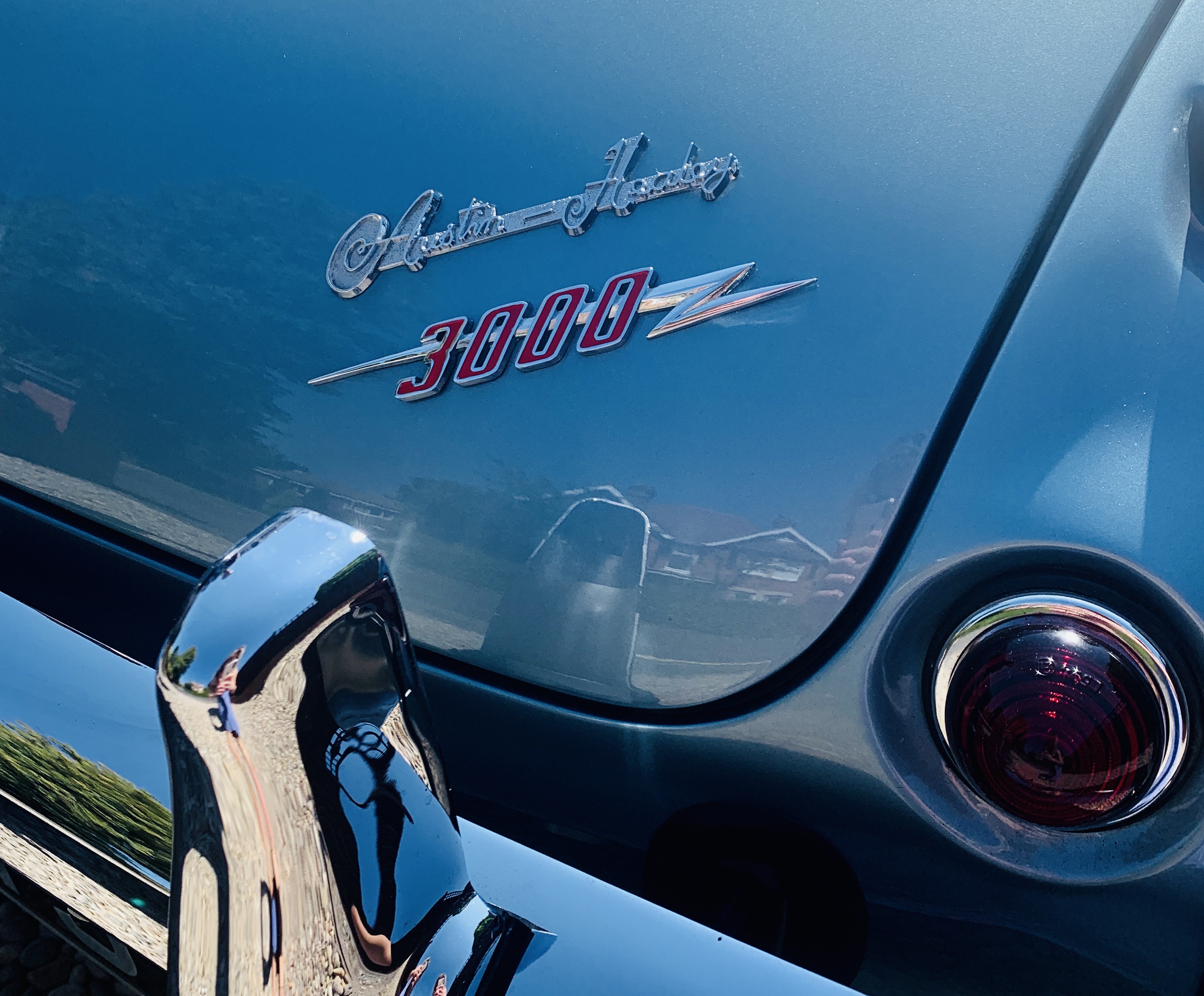
Austin-Healey 3000 MKIII

Date when launched 1964 discontinued in early1968
Total produced Abingdon 17,712

Price ex Works 
Oct 1965 £915

Engine 
2,912 cc 148bhp at 5,250 rpm Max torque 165 lbs/ft at 3,500 rpm
Length 13ft 1.5ins Width 5ft 0.5ins Height (hood) 4ft 1ins
Wheelbase 7ft 8ins Track front 4ft 0.8ins rear 4ft 2ins

Austin-Healey 3000 MkI .

Date when launched 1959 discontinued in 1961 Total produced Abingdon 2,825 BN7(2-seaters) 10,825 BT7(2+2 seater) Engine 2,912 cc 124bhp at 4,600 rpm Max torque 162 lbs/ft at 2,400 rpm Length 13ft 1.5ins Width 5ft 0.5ins Height (hood) 4ft 1ins Wheelbase 7ft 8ins Track front 4ft 0.8ins rear 4ft 2ins Price ex Works (Oct 1959) £1,168 (2 seater) £1,175 (2+2 seater)

NANCY WAS A EARLY MK1 3000

Austin-Healey 100-six BN4

Date when launched 1956 discontinued in 1959
Total produced Longbridge 1956/7 6,045. Abingdon 1957/9 4,241

Price ex Works Feb 1957 £1,144 

Engine 
2,639 cc 102bhp at 4,600 rpm Max torque 142 lbs/ft at 2,400 rpm
Length 13ft 1.5ins Width 5ft 0.5ins Height (hood) 4ft 1ins
Wheelbase 7ft 8ins Track front 4ft 0.8ins rear 4ft 2ins

Austin-Healey 100-six BN6
Date when launched 1958 discontinued in 1959
Total produced Abingdon only 4,150

Engine 
2,639 cc 117bhp at 4,600 rpm Max torque 142 lbs/ft at 2,400 rpm
Length 13ft 1.5ins Width 5ft 0.5ins Height (hood) 4ft 1ins
Wheelbase 7ft 8ins Track front 4ft 0.8ins rear 4ft 2ins

Model 100 BN2

Date when launched 1955 Discontinued in 1956
Total produced BN2 3,924

Price ex Works BN2 (1956 Jan) £1,126

Engine 
2,660 cc 90bhp at 4,000 rpm Max torque 150 lbs/ft at 2,000 rpm

Length 12ft 7ins Width 5ft 0ins Height (hood) 4ft 1ins
Wheelbase 7ft 6ins Track front 4ft 1ins rear 4ft2.8ins

Donald Healey converted 1,159 BN2 versions with a tuned engine.
Engine 2660cc comp.ratio 8.1 to 1. 110bhp at 4,500rpm Max torque 143 lbs/ft at 2,600rpm