
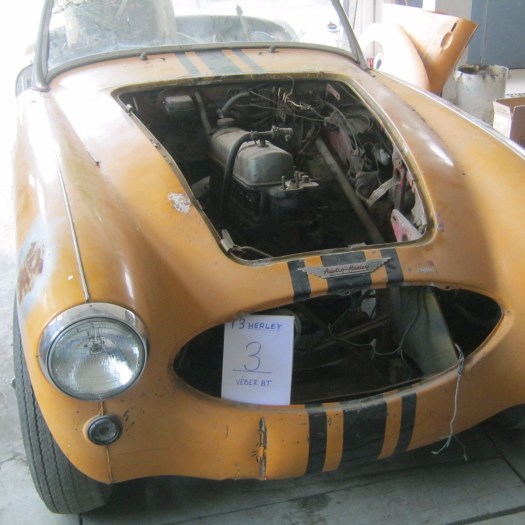

Mk1 Big Healey-the life, times and adventures
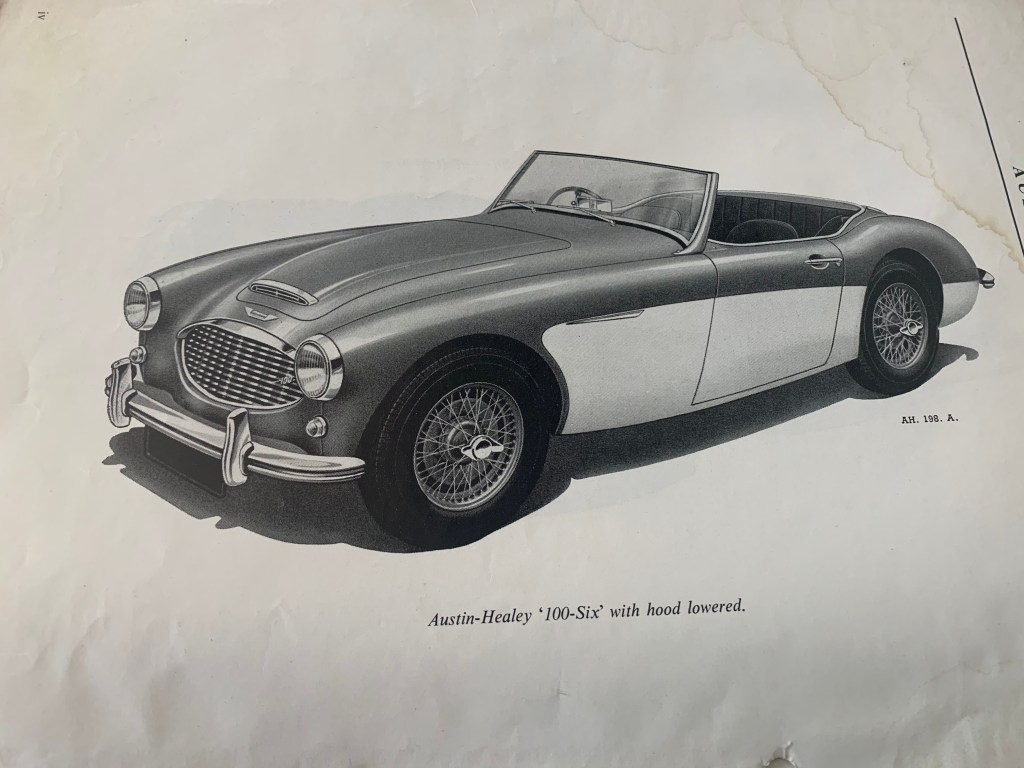
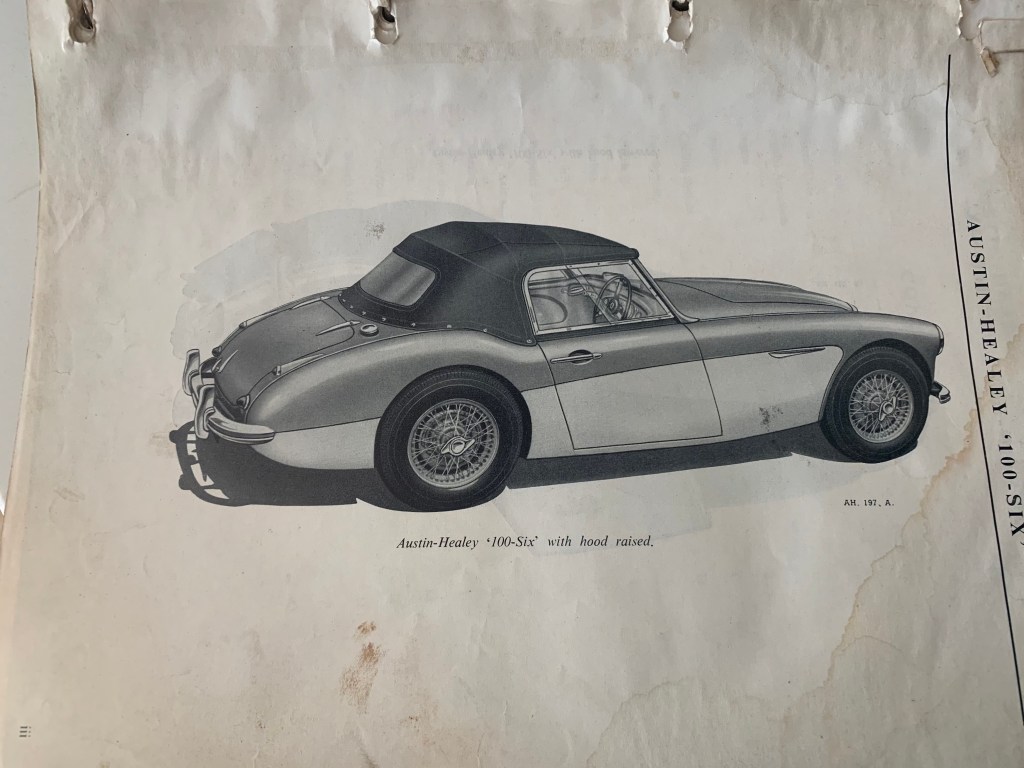
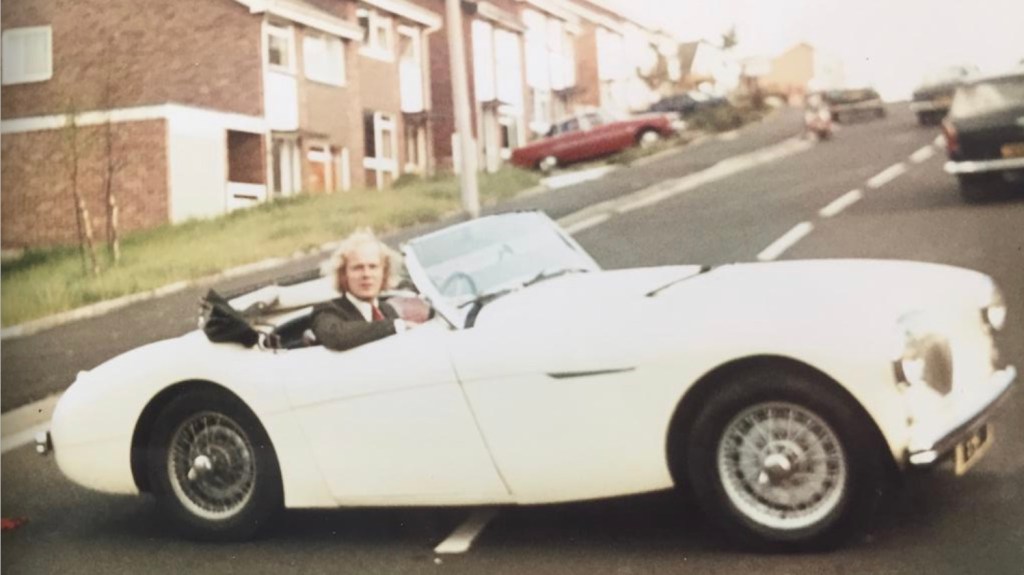
Austin Healey 100/6 BN4 ,Engine 97H 1489 was built in May 1957 , Martin owned it in the 1970’s. Loving the hair!!
He kindly sent me the original Service Manual, I will post a few of the amazing technical drawing images and general data pages….all fascinating .
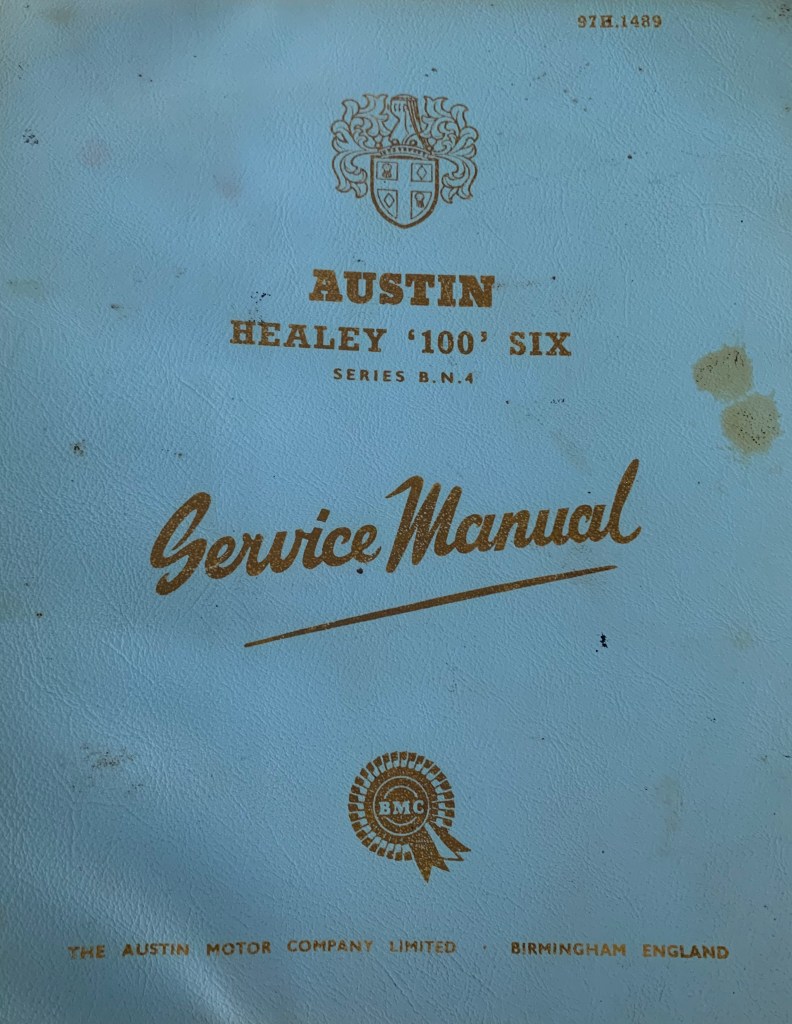
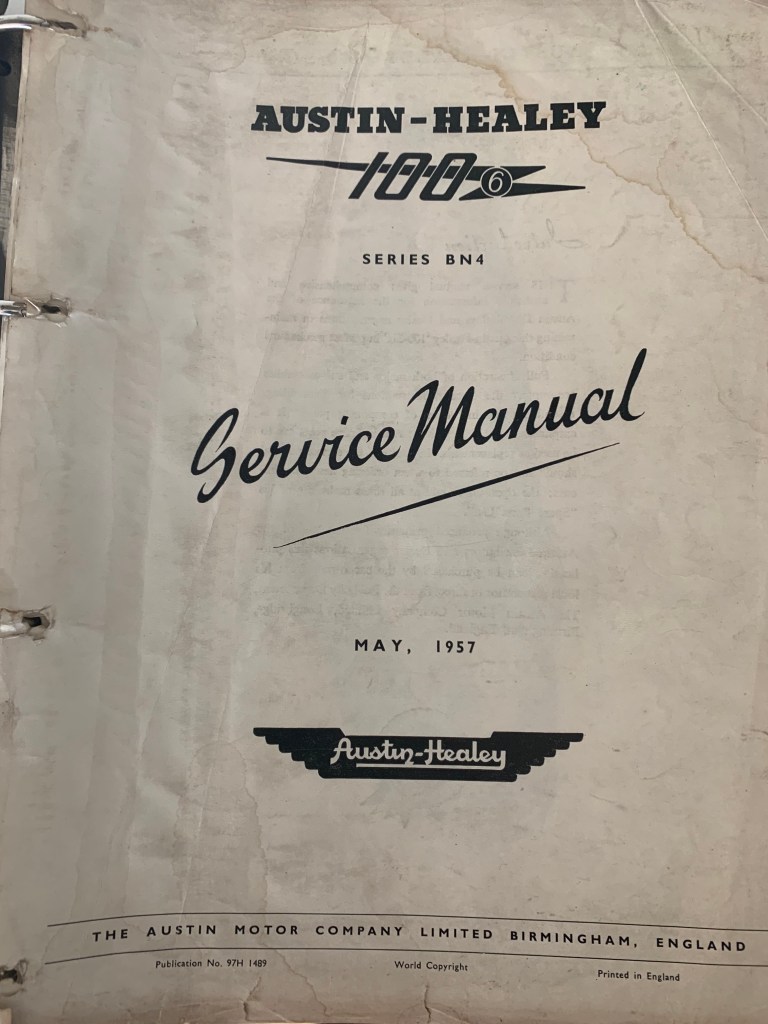
This is awesome ! Thank you #GoodwoodRevival #GRRC
Sorry I missed Goodwood this year but I thought I would share some classic car overtaking moves. (courtesy GRRC)
Known as the Big Healey to differentiate the model from the diminutive Austin-Healey Sprite, the Austin-Healey 3000 was a sportscar in the classic English vein built from 1959 to 1967.
Successor to the popular Austin-Healey 100-6, the 3000 was renamed to celebrate the adoption of a 3.0-litre in-line six-cylinder engine, offering up to 150bhp in its final Mark III guise. The 100-6 was itself a redesigned version of the Austin-Healey 100 series, a car that was based on Austin Atlantic running gear, and named for its ability to crack the magic ton – quite a feat in the early 1950s.
When the 3000 arrived, it quickly made its mark as a rally car, with many class victories to its credit under the auspices of the BMC competitions department. The 3000’s factory racing career ended in 1965 though, as BMW turned its attention to the giant-slaying Mini Cooper S.
The Big Healey has a reputation as something of a ‘hairy-chested’ sports car, thanks to its firm ride, heavy steering and grunty engine. Nonetheless it remains highly popular in the classic market today, thanks to its relative simplicity and muscular good looks.
Available both as a two-seater and a 2+2, the Big Healey to have is the 3000 MK III. It’s the last of the line, but also the best appointed with the most power and the most luxurious interior that included wind-up windows and a walnut dashboard.

“Soon, the Healey will be a collector’s piece. But no one who has sat behind the wheel of a Big Healey will forget the enduring excitement of it all—the huge surge of power, the tumultuous exhaust and the rest of the pack shrinking to dots in the mirror”. This was how Austin-Healey 3000 owner James Ewing paid tribute to the endearing character of the hairy-chested Big Healey in Safety Fast, some months after I’d watched the last true production Mk. III roil off the Abingdon Assembly line in December 1967.
He was right, of course. Today the Big Healey is an appreciating collector’s item. But the trouble with too many collectors’ cars is that they tend to be cosseted, treated gently, used for a few miles only on hot summer days out of respect for ageing and practically irreplaceable bodywork and mechanicals. The Big Healey was never meant for such cotton-wool treatment. It was meant for hard driving, the sort of scruff-of-the-neck motoring I indulged in with a then-young Mk. III for 14,000 memorable miles at the end of the ’60s. Today, Leyland spares for 3000s have almost dried up, but thanks to a handful of people like Derek Spencer, of D. Spencer Motor Engineering Ltd., 144 Fleet Road, Hampstead, London NW3, those lucky owners of the marque examples can continue to drive them regularly and forcefully, secure in a source of spares and craftsmanship which will keep their cars permanently youthful.
Spencer was practically forced into Healey specialisation by public demand after proving his worth with the marque in his preparation of SID 1, Healey-enthusiast Sid Segal’s racing 3000, at the beginning of the ’70s. In those early days the demand was for performance conversions and tuning; then came a shift to general repairs of engines, gearboxes, suspension and so on; now the pendulum has swung right over to complete rebuilds—”so many are coming in it’s ridiculous.” For now the moths are catching up with even the later Mk. 3s, inner and outer panels suddenly disappearing into brown, or aluminium-grey, dust. A few years ago, even when factory replacement parts were available, the cheap answer might have been to bolt on a set of glassfibre replacement panels. Now, as originality is essential to an appreciating asset, glassfibre is out for both Spencer and his customers, unless they’re daft enough to stipulate it.
To make this possible, Spencer has contrived to duplicate every exterior panel in the original material: steel where Jensen Motors produced steel panels for BMC, aluminium where the West Bromwich firm ulilised it for the front and rear shrouds. So now you Big Healey owners can take your chances with London taxis and buses with the same confidence as the rest of us in current production cars. Steel door panels, door shut faces, inner wings, outer and inner sills are produced too. Such specially-produced, low-volume parts, produced for Spencer by Oldham Panel and Sheet Metal Co., Tipton, Staffs, are necessarily more expensive than original Leyland parts; Spencer will supply factory front wings, of which there are still a few about, though probably not for long, for £30, while a Spencer steel wing, soon the only choice, will be twice that, or an aluminium replica, produced on the same jig, £90. Spencer rear wings, steel or alloy, are £50 each, complete front shrouds, aluminium, of course, £120, or available in sections. Inner wheel arches are £28 and door shut faces £8. Even bonnets can be made to order. A complete body rebuild, using such new parts and including spraying, would work out at roughly £1,200 to £1,400, depending upon the state of the chrome, says Spencer.
In fact Spencer has so many Big Healey parts available that he has thought seriously about building brand-new exact replicas and even raised the finance to do it. “But Rubery Owen dpn’t want to know about making new chassis” he says ruefully.
Spencer gave me a few “buying a Big Healey” body tips : “Some look good outwardly until you start prodding around the inner sills; that’s where you find hidden and forgotten Polyfilla. The inner rear wheel arches rot at the door shut-faces, the shut-face starts to flex, sets off the wing and then there’s real trouble. Chassis don’t rot much, only the occasional outrigger, which is easy enough to fabricate. Boot floors rot, too, but, again, they’re easy to fabricate. Fuel tanks corrode and are no longer available from Leyland, so we have them made. Underseal is the pain in the neck. You don’t see it until it catches fire and then a big hole appears in the rust underneath.”
Gearbox problems are the biggest headaches for existing owners or the main thing for the potential owner to watch out for. “Listen for a noisy gearbox. The supply of lay gears has dried up—they’re almost impossible to replace. If 2nd, 3rd or top helical gears have gone they’re in big trouble. We can’t get synchromesh parts either. Listen for noisy 1st and reverse—that’s an obvious sign of trouble. We are just scraping by that problem by having a new straight-cut (they’re non-synchro, of course) first gear built up and re-cut on the existing lay-gears. We’re working on having gearbox parts made, but the problem is trying to get costs to a reasonable level. It’s worse because of the old-fashioned helical angles, which nobody is tooled up for nowadays. The ironic part is that we could have a complete set of straight-cut gears made for the price of a helical lay-gear but they’d be too noisy.”
Overdrive spares shortages can be circumnavigated by interchanging bits from other units, particularly those from Jaguar Mk. 2s, but new casings are no longer available.
The supply of engine parts is perhaps the least difficult area. Just about the only things unavailable are Mk. III cams, “the only decent cam in the series, developed from the Sebring cam,” the supply of which dried up recently. However, reprofiling, “and actually improving,” existing cams removes that obstacle. He’ll supply a complete exchange engine unit for £325, or half-engine (less head) for £275, a short engine for £185 or an exchange block for £35.
Neither is suspension repair a difficult area, though new front coil springs have to be specially made. Ball-joints, track-rod ends etc., are readily available. “We have rear leaf springs made too; there’s no point in rebuilding them because the car soon goes lopsided. There’s no point in trying cheap shockabsorbers either. We’ve found that they just don’t last. We fit genuine replacement shockabsorbers or nothing—they last longer and they’re guaranteed.” Sometimes there’s a holdup on brake master cylinders, but otherwise no problem there either. Leyland’s stock of splined rear hubs is exhausted too, which means £25 to £30 each for new ones to be made.
“Steering boxes will probably be the next problem. We’re still able to recondition them, but for how long? We’ll have to have the things made.”
Just then Spencer’s co-director and human Healey part number computer John Ahtuam, a Mauritian, told Spencer that Leyland’s supply of nearside front hubs was exhausted. “We’ll have to have them made.” Which led Spencer to reiterate the feelings of so many Leyland marque specialists I’ve spoken to : “There’s no warning of when parts are going to be stopped by Leyland. And they just don’t want to know about rescuing redundant parts stock.”
Other pukka BMC parts which remain available include, fortunately, the complicated Mk. III exhaust system, at £48 plus hangers, or in smaller sections, and front bumpers. Spencer is currently arranging to have rear bumpers re-produced. Replica hoods, in mohair, double-duck or PVC, are produced by a local craftsman, who also carries out re-trimming to original specification. Spencer will use his old experience to carry out race engine and chassis preparation if requested, “But nowadays it costs too much and people don’t seem to be able to afford it. We do the occasional ‘rally’ engine for road cars and can supply a road/rally cylinder head conversion for £85 and road/rally cam for £35. A big problem for competition use is obtaining the essential straight manifolds for triple-Webers. If we’re desperate we can get them made, but at £150 a time.”
The invaluable, to Healey owners, business of this active Hampstead firm is split 70% between physical work on the cars and 30% on the supply of spares. In co-operating with Fred Draper’s A-H Spares, a 100% spares business at Leamington Spa, both Draper and Spencer benefit by pooling resources.
With men like Spencer and Draper around the longevity of the majority of those hairy-chested traditional sports car seems assured. Thank goodness.—C.R.
#brittanyferries #telegraph #classiccar
It’s important to pack elasticated shorts and voluminous kaftans when travelling to the Basque country. When the ship docks at Bilbao, it’ll be mere moments before you’re feasting on garlicky gambas (prawns) and bacalao (salt cod) with pil-pil sauce, accompanied by a glass of chilled albariño in the city’s numerous pintxo bars (similar to tapas).
To get under the skin of the Basque country, ship your car over to the continent with Brittany Ferries and load up on the region’s fine cheese, jamón and wine. With frequent sailings to Bilbao from Portsmouth, it’s never been easier to explore this delicious corner of Spain and France.

Before whizzing off to gorge on the delights of San Sebastián, it’s worth spending a day or so soaking up Bilbao’s many sights. Potter around Casco Viejo, the old town’s atmospheric 15th-century streets crammed with boutiques, cosy wine bars and hole-in-the-wall restaurants.
Spend an hour or three marvelling at the contemporary works by Jeff Koons, Mark Rothko and Andy Warhol et al at the Guggenheim Bilbao, the city’s titanium landmark edifice designed by Frank Gehry, which transformed the port city two decades ago. While fans of the classics will find plenty of El Grecos and Goyas to sate them at Museo de Bellas Artes.
From Bilbao, it’s a scenic hour’s drive east to San Sebastián, a charming seaside city famed for its sandy beaches, vibrant pintxosscene and a world-class culinary reputation with no fewer than 16 Michelin stars. The main beach gets packed in the warmer months, so follow the locals over to Isla Santa Clara, a tiny island just 437 yards wide with a quiet crescent beach, a natural seawater pool and a tiny beach bar.

From San Sebastián, it’s a short hop across the French border to Biarritz, a glamorous belle époque resort which found fame when Napoleon III took a shine to it in the mid-19th century. Park up at Hotel Escale Oceana, which is a short walk from the Old Town, where Bar Jean, one of Biarritz’s oldest hostelries has been serving up flamenco and tapas since the 1930s. Blow out the subsequent cobwebs with a potter along the Port des Pêcheurs, the old harbourfront staggered with crampottes, tiny fishermen’s cottages which back onto the cliffs.
Just east of Biarritz is Saint-Jean-de-Luz, a small fishing town with quaint, whitewashed bistros lining its narrow cobbled streets. Here you can while away the afternoon with the locals over a cloudy pastis and a bubbling crock of bonito marmitako (tuna stew) before heading over to Bayonne, the capital of the Basque country. A charismatic medieval city – all rugged ramparts, half-timbered buildings and tempting riverside restaurants – it’s like walking through a French impressionist’s painting and is regarded as one of the prettiest cities in Europe.

Work off the bountiful Basque cuisine by driving 90 minutes north to Landes de Gascogne Regional Natural Park, where you’ll find numerous hiking trails and lakes to explore on foot or by canoe, as well as the Contemporary Art Forest, a walking trail which combines art and nature.
Now in the lush heart of Aquitaine, resplendent in corduroy-neat vineyards of some of the world’s greatest wineries, it’s time to book into a 17th-century manor house and spend a few days exploring the beautiful sun-drenched winelands of Bergerac and Saint Émilion. After that third glass of Margaux and a fine entrecôte bordelaise, you’ll be delighted you packed those comfy clothes.
Find out more at brittanyferries.com/telegraph

THE new BMC. Drawing Office Building at Longbridge, will enable the main design forces of the group to be concentrated under one roof for the first time. Another big step forward in realizing the aims for which the BMC. was formed. It will be completed in June.
At the moment the various design departments are scattered throughout the Corporation’s factories, making co-ordination difficult. The new building will help BMC. to pursue still more vigorously the policy of standardization and ‘commonization’ of components to achieve the greatest economies in production.
A striking feature of the handsome new building, designed by the BMC. architects, Harry W. Weedon, FRIBA. & Partners, is the excellence of the working conditions.
Design staff will enjoy an exceptional amount of natural light at their drawing-boards, as well as abundant fresh-air ventilation, with-out draughts.
This vast general drawing office cost £550,000 and is nearly 60,000 sq.ft. in area as big as many a factory. (It is, incidentally, twice the area of the BMC. Joy Car Factory at Bargoed, where 350 people are employed.)
It will receive a high degree of available daylight through six ‘monitors’-glass-sided raised portions in the roof. And on sunny days there need be no fears of the atmosphere getting uncomfortably hot; an efficient extraction system takes care of that. The air flow can be increased by 50 per cent. in warm weather.
Artificial general lighting is provided by recessed fluorescent fittings with directional reflectors. The main entrance, with executive offices and conference room, faces one end of the lawn in front of the Administration Block-to which the Drawing Office is connected by a bridge with lifts at each end. Among other features are print rooms, and a special drawing office of 7,840 sq. ft. above the main executive offices.
Mr. Geoffrey Eyre, BMC. Building Projects Engineer, told BMC. World: ‘The object of the exercise is to give the maximum daylight when it is there, and as much fresh air as we can possibly put in without draughts. ‘The lighting has been very carefully designed.’
 Nancy the Austin Healey